Culinary Shenanigans 1 | Kanel/Kardemummabullar
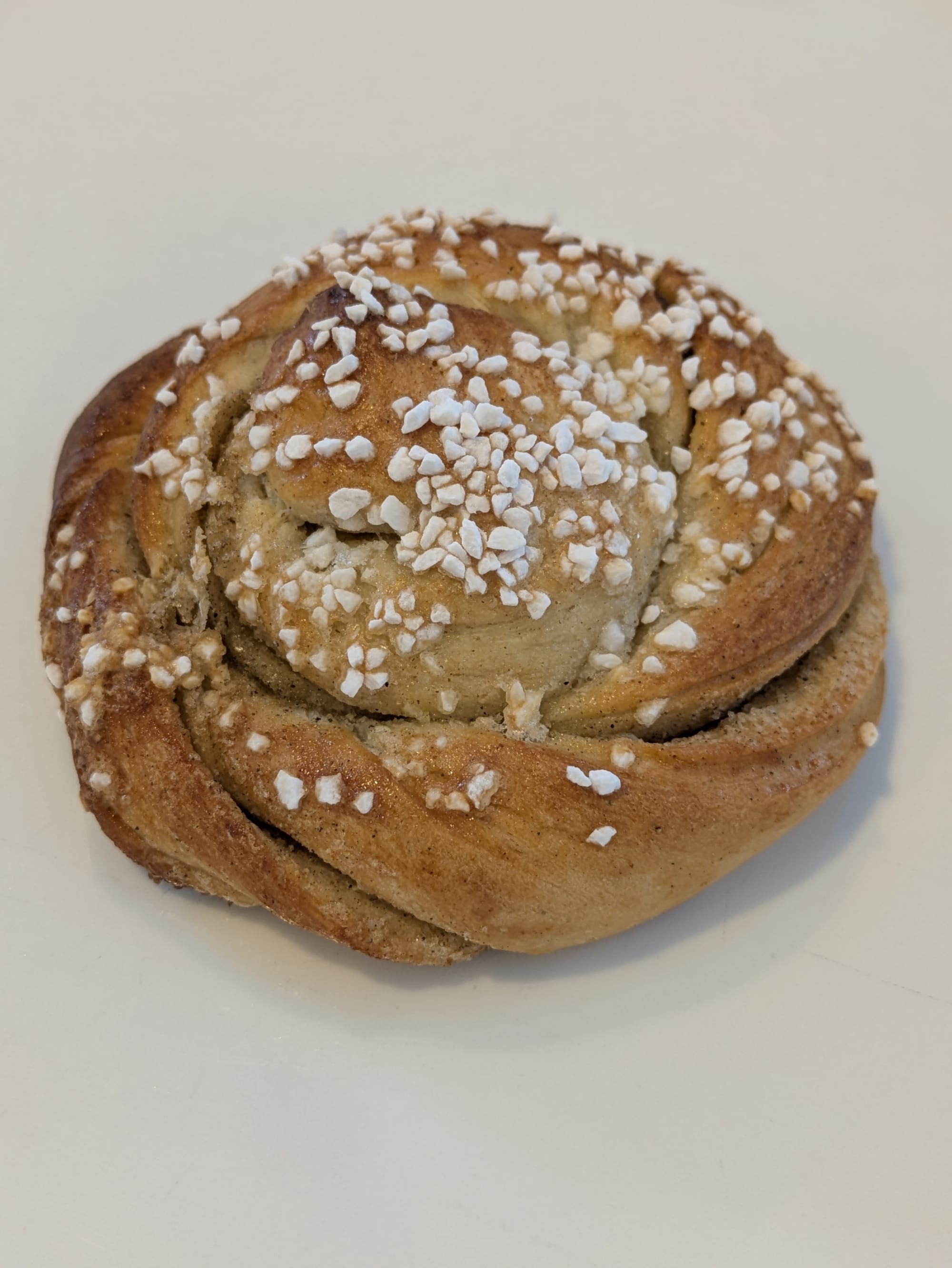
I figured it was long past time I posted some of my culinary adventures on my blog, so lets start with one of my biggest special interests: the Swedish Style Cinnamon Bun (Kanelbulle) and its cousin: the Cardamom Bun (Kardemummabullen).
You get a history lesson first because this is my blog and I can do whatever I want.
History
When "exotic" spices like cinnamon started to make their way into northern Europe, bakeries often experimented by adding them into bread dough. These spiced breads were particularly popular in Germany and Sweden and possibly led to the creation of what we know as the cinnamon bun. According to The Oxford Companion to Sugar and Sweets there are some German cookbooks from the 1500s that have early forms of the cinnamon bun.
The concept of cinnamon buns has been around for a long time, however they are a relatively "new" pastry to the general population because the primary ingredients for cinnamon buns did not become affordable until after the World Wars. Following this decrease in cost, cinnamon buns become a staple within Swedish culture where they have remained extremely popular ever since, mostly due to Fika, a cultural tradition that probably deserves its own blog post.
The history of cardamom buns is probably similar, however there is even less documentation for them throughout history than cinnamon buns, but that does not take away their popularity within Sweden and they are undoubtedly my favorite of the two.
Technicality
Swedish-style buns can generally be characterized by a dense, cardamom-infused dough, a mild sweetness, topped with an egg wash and pearl sugar. Cardamom buns (kardemummabullar) are nearly identical, but the cinnamon in the filling is replaced with cardamom, giving the better spice (in my opinion) the spotlight. The characteristics listed here create an often unexpected opposition to the sugar-focused, icing covered "American-style" abominations common in North America.
There are three ways of forming the rolls. All of these are usually done with each bun being separated rather than in one big sheet pan like American-style cinnamon rolls. It may not be needed to say, but these techniques all take place after the dough has been formed into a large rectangle and covered in filling.
Rolling - The dough is rolled up into a log and sliced.
Twisting - The dough is folded over once, rolled a bit more and sliced. Once sliced, each slice is stretched a bit, twisted, then coiled. This is my favorite method.
Knotting - The dough is folded over once, rolled a bit more and sliced. Once sliced, each slice is stretched a bit, twisted, then tied into a knot by wrapping the "rope" around your finger(s) a few times and tucking the end through the middle. Slightly more involved than the former two methods but very pretty!
The Funny Words
You may have noticed my occasional usage of Swedish, so I wanted to explain the difference between the forms of each word to reduce confusion.
(en) Kardemummabulle - (A) Cardamom Bun
Kardemummabullar - Cardamom Buns
Kardemummabullen - The Cardamom Bun
Kardemummabullarna - The Cardamom Buns
The rest of this section is just grammar nerd stuff so you can skip it if you want. In Swedish a noun is either an "en" or "ett" word. For our two words today, both are "en" so their ending forms are the same. When you learn a word you are supposed to also learn its form (if you want to learn "fish" you would learn it as "en fisk", not just "fisk"). In my studies I had originally failed to do so and it made my life harder. Learning these forms are crucial, because "en" or "ett" will dictate word forms in more complex sentences.
As for the endings "en" words usually have a -e ending, plural have -ar, "the" has -en, and plural "the" has -arna. If you wanted to say "The Cardamom Bun is [the] best!" you would say: "Kardemummabullen är bäst!"
Additional Fun Facts
In Sweden, October 4th is Kanelbullens dag or "Cinnamon Bun Day".
Over 7 million Cinnamon buns get sold on Kanelbullens dag.
Guatemala is the world’s number 1 producer of cardamon, even though it is a native spice to India.
Sweden consumes 18 times more cardamom per capita than the global average.
It is estimated that Sweden consumes about 300 cinnamon buns PER PERSON annually!
EU Regulation No. 1334/2008 limits a lot of food flavorings, including the reduced amount of coumarin (a major component of some cinnamon species) allowed in foods. Once it went into affect, the Swedish National Food Agency "Livsmedelsverket" classified cinnamon buns as traditional baked goods, exempting them from the limit.
References
Goldstein, D. (2015). The Oxford Companion to Sugar and Sweets. https://doi.org/10.1093/acref/9780199313396.001.0001
Kanelbullens dag – kanelbullens dag. https://kanelbullensdag.se/
Hofverberg, E. (2018, October 4). The Making of a Legal Cinnamon Bun | In Custodia Legis: Law Librarians of Congress. Blogs.loc.gov. https://blogs.loc.gov/law/2018/10/the-making-of-a-legal-cinnamon-bun/